Understanding Your Bank Statement & Payment Activity
Your bank statement tells a story. Do you know what it’s saying?
Let’s be honest.
Most of us only open our bank statement for one reason: to check whether we’ve been paid or to see how much money is left in our account. Once we’ve seen the balance, we close it and move on.
But your bank statement is much more than a list of transactions.
It provides a snapshot of your financial life. It shows where your money came from, where it went, the commitments you’ve made, the habits you’ve formed, and sometimes even the financial pressures you may not have realised were developing.
Taking just a few minutes each month to review your statement can help you better understand your finances, identify unusual activity early, and make more informed financial decisions.
What is a bank statement ?
A bank statement is a record of all transactions that occurred on your account over a specific period.
Whether you receive it through your banking app, internet banking or email, it provides a summary of your financial activity, including:
Salary and other deposits
Electronic transfers
Instant payments
Debit orders
Card purchases
Cash withdrawals
Bank charges and fees
Interest charged or earned
Your opening and closing balances
Think of it as your monthly financial diary.
Let’s read a bank statement together:
Instead of focusing only on the closing balance, let’s look at what this statement is telling us.
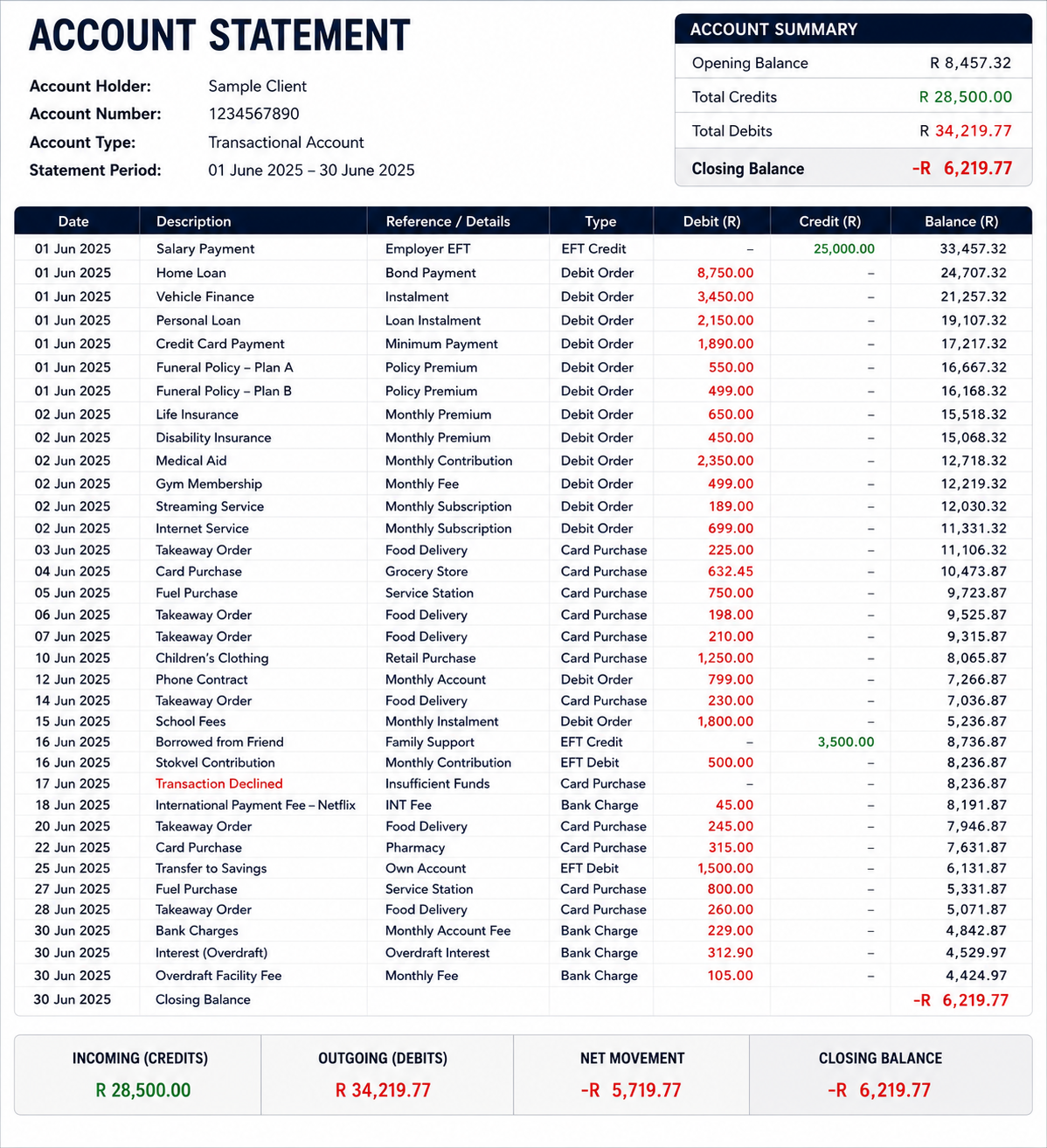
Disclaimer: This bank statement used in this article is fictional and has been created for educational purposes only. It does not represent any financial institution or customer. The transactions descriptions, dates, and values have been included solely to illustrate examples of payment activity that may appear on a transactional bank account.
1. Income tells the beginning of the story
For many people, the first chapter of a bank statement’s story begins with a salary or wage payment entering the account.
As the month progresses, another credit appears, money received from a friend or family member.
There are many reasons for this, including financial assistance, a loan, or repayment of money previously lent. However, if receiving financial assistance becomes a regular occurrence to make it through each month, it may be worth asking whether monthly expenses have started exceeding available income.
Sometimes our bank statement identifies financial pressure before we consciously recognise it ourselves.
2. Your commitments come first
Shortly after payday, several debit orders are processed.
These may include financial commitments such as:
Home loan
Vehicle finance
Personal loan
Credit card repayment
Insurance policies
Medical aid
Internet services
Gym membership
Streaming subscription
Stokvel contribution
For many South Africans, this pattern is familiar. Debit orders are commonly scheduled shortly after salary payments to ensure obligations are met.
Looking at these transactions together provides an opportunity to pause and ask:
Do I still need every subscription?
Am I paying for services I no longer use?
Do I recognise every debit order?
Are all these deductions still authorised?
Even relatively small monthly commitments can have a significant impact when combined.
3. Everyday spending reveals habits
As the month continues, card purchases begin to appear.
Groceries, fuel and clothing are all part of everyday life.
But another pattern starts to emerge. Perhaps there are several food delivery purchases spread throughout the month. Individually, each transaction may not seem significant. Collectively, however, they represent a noticeable portion of monthly spending.
One of the greatest benefits of reviewing your bank statement is that it allows you to see spending patterns that are often difficult to notice while they’re happening.
Your statement doesn’t judge your spending it simply reflects your financial behaviour.
4. Small charges deserve your attention too
Towards the end of the statement, several additional charges appear, including:
Monthly account fees
International payment fees linked to international subscription services
Declined transaction fees
Interest charges
Overdraft-related fees
These charges may seem small individually, but together they still reduce the money available to you.
Understanding why these fees appear can help you avoid unnecessary costs and better manage your account. In some cases, recurring fees may indicate that it’s worth reviewing how you use your account or whether a different account type may suit your needs.
5. Your bank statement can also help protect you
Reviewing your statement isn’t only about budgeting.
It’s also one of the simplest ways to identify unusual or unauthorised activity.
As you review your statement, ask yourself:
Do I recognise every debit order?
Do I recognise every card purchase?
Have any new subscriptions appeared?
Are there transactions I don’t remember making?
Do I understand every fee charged to my account?
Is there anything that doesn’t look right?
The sooner unusual activity is identified, the sooner you can contact your financial institution and, where applicable, follow the appropriate dispute or fraud reporting process.
Your bank statement is a financial health check
Many people only review their statement when something goes wrong.
Instead, consider making it part of your monthly routine.
Your bank statement can help you:
Understand where your money is going.
Identify unnecessary spending.
Confirm that debit orders remain authorised.
Detect unusual account activity.
Monitor your financial commitments.
Make more informed financial decisions.
Financial wellbeing isn’t only about how much you earn. It’s also about understanding how your money moves and how your financial decisions shape your overall financial health.
Pause & Reflect
Before you close this article, take a moment to open your latest bank statement and ask yourself:
1. Can I identify every debit order on my account?
2. Which expenses surprised me the most?
3. Are there subscriptions or services I’m no longer using?
4. Have I relied on borrowed funds or financial assistance to get through the month?
5. If my bank statement reflects my financial habits, what does it reveal?
Closing Thoughts
Understanding your bank statement is one of the simplest yet most powerful financial habits you can build.
It doesn’t simply record transactions, it provides insight into your financial commitments, your spending patterns, and your overall financial wellbeing.
The more familiar you become with your payment activity, the better equipped you’ll be to make informed decisions, identify unusual transactions early and take greater control of your finances.
Because financial wellbeing doesn’t begin when you invest, save or borrow.
It begins with understanding.
Disclaimer: This guide is an original educational resource. Additional industry, as well as your respective bank, can be consulted for more in-depth guidance. You are encouraged to explore further insights.